What is the difference between high-frequency current probes and low-frequency current probes
A current probe, also known as a current clamp, is a magnetic ring designed based on Faraday's principle to measure interfering current signals in a wire. Essentially, it is a transformer with one turn. The use of a current probe can measure the magnitude of the current flowing through the wire. Current probes are divided into AC/DC current probes and AC current probes.
The former can measure the magnitude of DC and AC currents, while the latter can only measure the magnitude of AC currents. Although the current probe is not as common as the voltage probe of an oscilloscope, its function cannot be replaced by other probes. It can measure the current flowing through the wire without damaging it. When used in conjunction with a voltage probe, it can provide power, phase, and other data. This is very useful for measurement systems.
Current probes are mainly divided into two types: high-frequency and low-frequency. The main differences are as follows: high-frequency current probes use T large-scale integrated circuits, which are sturdy and reliable in structure and not easily damaged. They are mainly used to measure signals with frequencies above 20K and have the characteristics of high bandwidth and low current. By utilizing the principle of electromagnetic induction and using magnetoelectric sensors for detection, the relative cost is high and the process is complex.
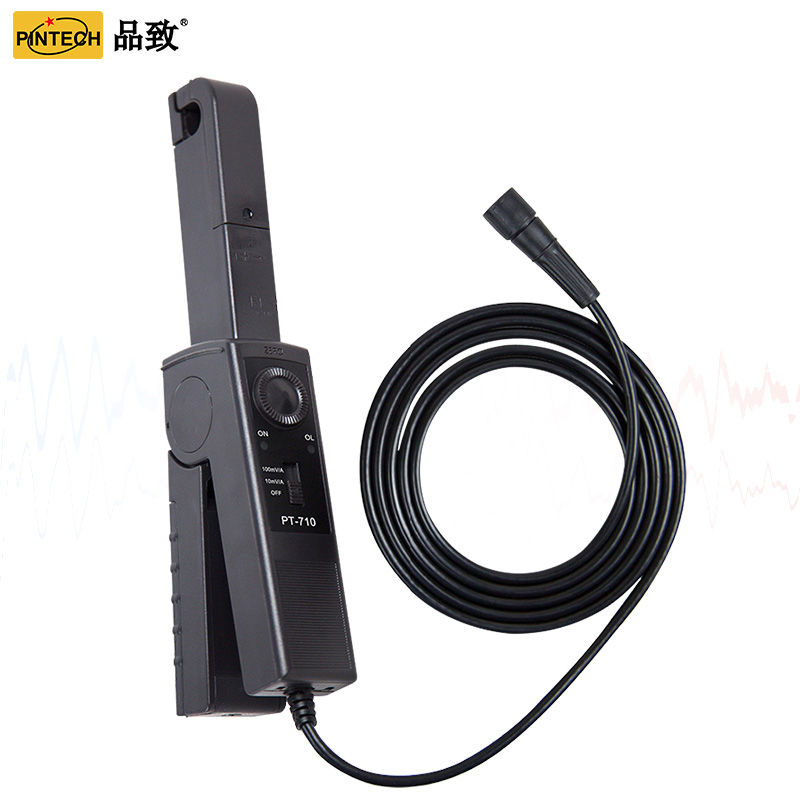
Features include: high bandwidth, accurate and fast capture of current waveforms; High precision, with an accuracy of over 1% within the current measurement range, meeting the needs of most fields;
Two measurement ranges can be selected for small current measurement;
Automatic demagnetization and zero adjustment function, easy to use; Sound and light overcurrent alarm function, reminder range switching;
Electronic button design, standard BNC output interface with longer lifespan, can be matched with any manufacturer's oscilloscope. The low-frequency current probe adopts a Hall sensor with automatic zero adjustment function, which is convenient to use;
Equipped with power supply and battery low voltage alarm indicator, overload alarm sound;
Battery power or external power can be used to make measurement more convenient;
The BNC output interface is accurate and easy to connect with oscilloscopes and other devices. The BNC dual banana plug can be used to connect a multimeter to measure AC and DC current. It is mainly used for measuring signals below 1K. It has the characteristic of a large current range.
Key points for use:
A. The wire used for capacitance should be a wire with a cross-sectional area of 05mm2 (AWG20) or more.
B. When connecting the tested capacitor to the wire, move the capacitor to the tin side of the substrate, and shorten the wire as much as possible.
I'm here to say goodbye to everyone. I believe that after reading this article, everyone will have something to gain. I hope it can be helpful to everyone. Thank you for your reading and attention.

TOP




 中
中 EN
EN Current location: