Differences between power analyzers and power meters
Power instruments are indispensable products in power supply. If it were not for the development of frequency conversion technology, if there were no nonlinear loads, and if all the measurements were sinusoidal or direct current, a power meter would be sufficient in terms of power, and it is estimated that there would not be a power analyzer product. Below, I will briefly introduce the differences between power meters and power analyzers.
A power analyzer is an instrument that measures electrical power and other electrical parameters, also known as an electrical parameter analyzer. In addition to the important parameter of power, the power analyzer can also detect other electrical performance parameters, such as voltage, current, power factor, etc. The power analyzer is a device mainly used for measuring the electrical parameters of power electronic products. Of course, it is also suitable for monitoring and analyzing the quality of power grid operation, providing harmonic analysis and power quality analysis in power operation.
Power analyzers are usually composed of voltage/current sampling circuits, microprocessor operation circuits, display circuits, communication circuits, PC software, power circuits, etc.
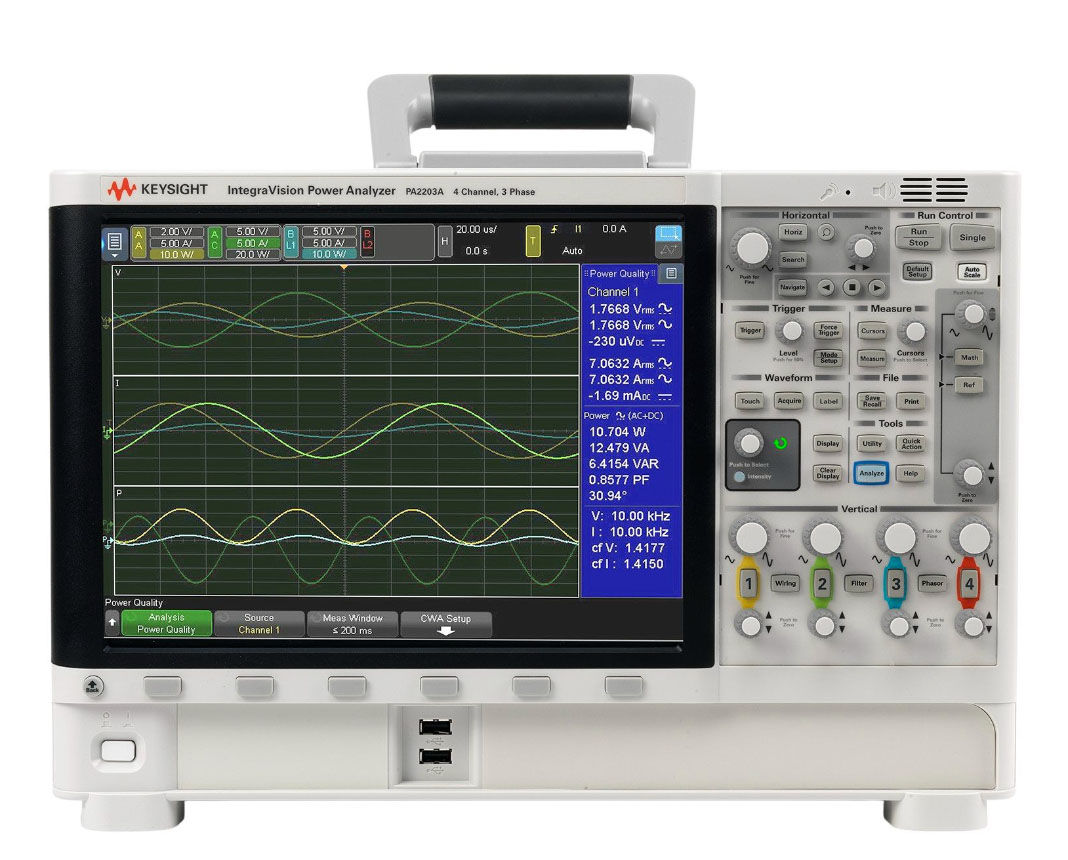
The sampling circuit is divided into two parts: voltage sampling and current sampling. Voltage sampling usually uses resistance buck sampling, while current sampling uses current transformer CT isolation sampling. Each part includes signal amplification, automatic range processing, anti aliasing low-pass filtering circuit, and ADC analog-to-digital converter. This circuit quantifies and samples the input AC signal, and then performs digital processing through a microprocessor operation circuit, displaying the measurement data on the panel.
The power analyzer has all the functions of a power meter. Due to the fact that the tested object often contains harmonics, the characteristics of voltage and current signals cannot be measured solely by the effective value parameter. Therefore, power analyzers often also have functions such as real-time waveform and harmonic analysis.
In contrast, the function of a power meter is relatively simple, mainly measuring the effective values of voltage and current, as well as parameters such as active power and reactive power, mainly used for measuring power frequency or direct current parameters.
The above is the entire content of this article. Friends who like this article should not forget to forward and bookmark it! Thank you for reading and look forward to seeing you again in our next issue!

TOP




 中
中 EN
EN Current location: